

Ten years in UAE food and beverage has taught me one thing about dessert programs: they break quietly. Nobody notices the slow slide from “great” to “fine” until covers start dropping and nobody can say exactly why.
Almost every time, the root cause traces back to one decision — who’s actually making your desserts, and whether that production can keep up as you grow.
This is the framework I use with restaurant groups, hotels, and cloud kitchens across the UAE when they’re evaluating a dessert supplier for cafes Dubai wide, or weighing whether to bring in a custom dessert manufacturer for restaurants for the first time.
Why In-House Dessert Production Becomes Difficult as Restaurants Grow
Running your own pastry section works fine at one location. It starts cracking the moment you scale.
- Labour and staffing challenges — pastry chefs are in short supply in the UAE, and turnover is constant
- Portion inconsistency — the dessert on table 4 doesn’t match the one served last Tuesday
- Rising food costs — small-batch ingredient purchasing at retail scale eats into margin fast
- Seasonal demand fluctuations — your kitchen can’t flex up for Ramadan and back down for August
- Limited menu innovation — recipe development takes a back seat when the team is just trying to keep up with daily covers
None of this means your kitchen is doing anything wrong. It means dessert production is a specialist function, and most restaurant kitchens weren’t built to specialise in it.
What F&B Managers Should Expect from a Dessert Production Partner
A real dessert production partner UAE restaurants can rely on isn’t just a delivery service. It should function like an extension of your kitchen:
- Reliable production capacity that holds up during your busiest service, not just an average Tuesday
- Standardised recipes — documented, repeatable, and not dependent on who’s working that shift
- Consistent presentation — the plated dessert photographed for your menu should match what arrives every time
- Flexible ordering that adjusts to your actual volume instead of locking you into rigid minimums
- Quality assurance systems — documented batch checks, not just a verbal promise of consistency
If a supplier can’t speak confidently to all five, they’re a vendor, not a partner.
A Practical Framework for Choosing a Dessert Supplier in Dubai
Here’s the checklist I walk every new client through before they sign anything:
- Product quality and taste consistency — sample across multiple batches, not one cherry-picked box
- MOQ requirements — confirm minimums per SKU before assuming they’ll fit your volume
- Delivery schedules and lead times — get this in writing, including what happens during peak weeks
- Shelf life and storage — know exactly how long a product holds and under what conditions
- Menu customisation capabilities — can they adjust a recipe, or are you locked to the catalogue?
- Scalability for multiple branches — can they grow with you, or are they maxed out at your current volume?
Run a serious supplier through these six points before the conversation moves to pricing. Price means nothing if the product can’t hold up at scale.
In-House Baking vs Outsourcing vs Custom Manufacturing
This is the comparison most restaurant owners haven’t actually mapped out — they just default to whatever they started with.
| Factor | In-House Baking | Outsourcing (Wholesale) | Custom Manufacturing |
| Cost structure | High fixed cost — chef salary, equipment, waste | Lower, predictable per-unit cost | Higher upfront, lower long-term once scaled |
| Staffing requirements | Dedicated pastry chef and team | None — supplier-managed | Minimal — collaborative briefing only |
| Speed of expansion | Slow — new kitchen needs new hires | Fast — same supplier, new location | Moderate — recipe scales once developed |
| Menu flexibility | High, but limited by chef’s time | Limited to supplier’s catalogue | Fully flexible, built around your brief |
| Operational complexity | High | Low | Low to moderate |
The honest answer: most growing restaurants start with outsourcing for consistency, then move into custom manufacturing once they know exactly what differentiates their brand.
How Leading Restaurants Plan Dessert Menus Around Dubai’s Seasonal Calendar
The UAE has a genuinely predictable demand calendar. Suppliers who plan for it perform; suppliers who don’t, scramble.
- Ramadan and Eid — date-based desserts, gifting formats, and iftar buffet volume spike hard
- Dubai Summer Surprises — lighter, frozen, and fruit-forward desserts outperform heavy cakes in peak heat
- Corporate gifting season (Q4) — premium, branded dessert boxes see substantial demand
- F1 Abu Dhabi and tourism peaks — high-spending visitors raise the ceiling on premium pricing and presentation
- Winter outdoor dining season — longer alfresco service hours mean steadier daily dessert volume
Ask a prospective supplier how they handled last Ramadan specifically. Vague answers mean they haven’t actually been tested.
Why Portion Consistency Matters More Than Variety
Restaurant owners chase variety. Guests remember consistency.
- Guest experience — a dessert that tastes different each visit erodes trust faster than a short menu ever will
- Brand reputation — one inconsistent plate posted online can undo months of good reviews
- Food cost control — inconsistent portions make food cost forecasting nearly impossible
- Multi-location operations — consistency is the only way a guest gets the same experience at every branch
A tighter, more consistent dessert menu will almost always outperform a wide, unpredictable one.
Which Desserts Perform Best for Restaurants and Cafés in Dubai
A handful of formats consistently perform well across Dubai’s restaurant and café scene:
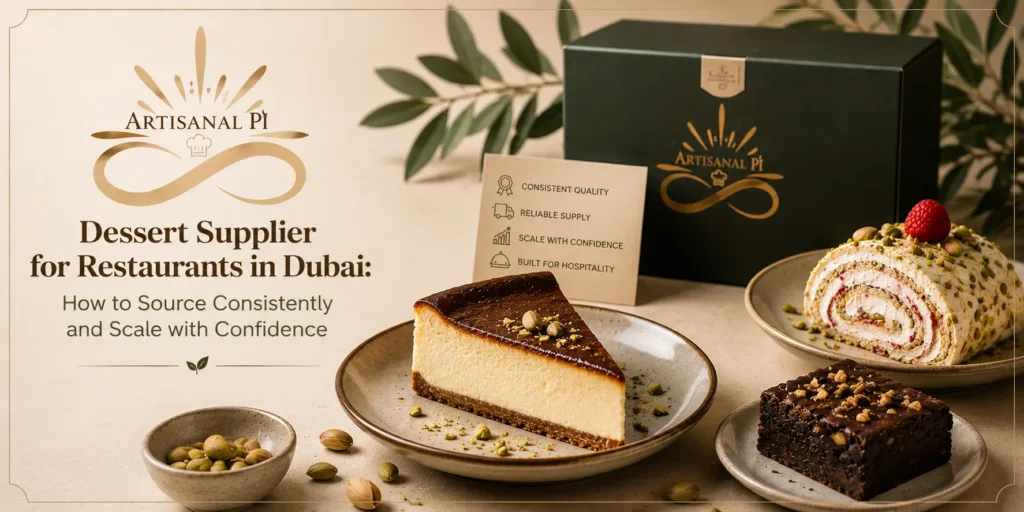
- San Sebastian Cheesecake — burnt-top, creamy centre, instantly recognisable
- Pistachio Meringue Roll — visually striking, plays into the city’s love of pistachio and rose
- Opera Cake — premium positioning, holds its price point well
- Tiramisu — a menu staple that guests order on repeat
- Flourless Brownie — covers gluten-free demand without sacrificing indulgence
- Individual plated desserts — ideal for fine dining and hotel à la carte menus
We curated exactly this kind of lineup into The Dark Side, and we’ve gone deeper into premium positioning for hospitality specifically in Premium Desserts in Dubai for Hotels and Cafés.
Building High-Margin Dessert Menus Without Increasing Kitchen Complexity
The goal isn’t a bigger menu. It’s a smarter one.
- Ready-to-serve concepts — desserts that arrive plate-ready, not requiring reconstruction by an already-stretched kitchen
- Labour savings — no dedicated pastry hire needed to run a strong dessert section
- Reduced waste — order to actual demand instead of over-producing “just in case”
- Menu engineering principles — pair high-margin desserts with strong visual appeal to drive attach rate
We laid out the full menu-engineering approach in our café dessert menu guide — worth a read if you’re rebuilding your dessert section from scratch. And if your all-day menu needs savoury balance alongside the sweet, items like a well-made zaatar croissant or a proper cheese croissant round out a bakery case without adding kitchen complexity.
Meeting Demand for Sugar-Free, Gluten-Free, and Vegan Desserts
Dietary requests aren’t an edge case anymore — they’re a baseline menu expectation in Dubai.
- Health-conscious diners are actively choosing venues based on whether they offer real alternatives, not an afterthought
- Corporate wellness trends are pushing hotels and offices to demand healthier catering options
- Hospitality dietary requirements now routinely include sugar-free, gluten-free, and vegan as standard, not special-order
- Inclusive menus simply convert better — guests bring friends with dietary restrictions when they know there’s something for everyone
Our Sol range was built specifically to close this gap, and we go deeper into the category in our sugar-free dessert guide.
How Cloud Kitchens in Dubai Use Centralised Dessert Production to Scale Faster
Cloud kitchens have a structural advantage most traditional restaurants don’t: they can launch new virtual brands without new physical infrastructure — as long as production can keep up.
- Operational efficiency — one supplier feeding multiple virtual brands from a single facility
- Inventory management — centralised dessert supply simplifies stock control across concepts
- Faster expansion — adding a new delivery-only brand doesn’t require new kitchen equipment
- Brand consistency — every virtual concept gets the same reliable product, regardless of which app it’s listed on
For operators weighing this exact decision, we wrote about it directly in Why Every Café in Dubai Needs a Dessert Supplier in 2026.
When It Makes Sense to Move Beyond Standard Supply and Develop Signature Desserts
Wholesale supply solves consistency. It doesn’t solve differentiation.
Once your dessert program is stable, the next question becomes: is there a dessert only your brand serves?
- Exclusive recipes built around your concept, not pulled from a shared catalogue
- Brand differentiation — a signature item competitors genuinely can’t replicate
- Limited editions tied to your own calendar, not someone else’s seasonal menu
- Chef collaboration — a development process, not a one-off custom order
This is exactly what Palate Laboratory was built for — working with restaurant groups and hotels who are ready to move past the catalogue.
From Restaurant Menu to Private Label Brand: The Next Stage of Growth
For some operators, signature desserts are just the start. The next stage is turning that product into an actual retail brand.
- Recipe development — refined through tasting rounds against your brief
- Product testing — validated for taste, shelf life, and production consistency
- Packaging — designed for retail shelf presence, not just kitchen delivery
- Commercialisation — scaled from restaurant-only to broader distribution
- Retail opportunities — supermarkets, gifting channels, or your own delivery-only dessert brand
We mapped this entire journey in Private Label Desserts UAE: How to Launch Your Own Brand — including realistic MOQs and timelines for restaurant groups exploring this path.
Common Questions Restaurant Buyers Should Ask Before Signing with a Supplier
Before you commit, get clear answers to these:
- What are your MOQs, per SKU?
- What are your actual lead times — not the best-case scenario?
- Can recipes be customised, or is the catalogue fixed?
- Can production scale if we open a second or third location?
- How do you ensure consistency from batch to batch?
- Are sugar-free and gluten-free options genuinely available, not just listed?
A supplier who answers all six clearly and confidently is worth a serious conversation. One who deflects isn’t ready for restaurant-scale supply.
Supporting Restaurants Across Dubai and the UAE
This framework applies whether you’re running a single café in Jumeirah or a multi-brand operation across the city:
- Jumeirah cafés — premium positioning, high guest expectations
- DIFC restaurants — fast lunch service, strong dessert attach rate
- JBR dining concepts — high footfall, tourist and resident mix
- City Walk venues — experience-driven dining, strong visual presentation needs
- Al Quoz cloud kitchens — delivery-first, consistency across multiple virtual brands
- Hotel groups across the UAE — banquet-scale volume alongside à la carte precision
Different contexts, same underlying need: a dessert partner who shows up the same way every time.
Why Collaborative Dessert Development Creates Long-Term Competitive Advantage
The restaurants winning in Dubai right now aren’t competing on volume. They’re competing on quality over quantity, creativity over convention, and collaboration over compromise.
That’s the philosophy behind how we built Artisanal Pi — wholesale consistency through The Dark Side, custom and signature development through Palate Laboratory, and a dedicated health-focused range through Sol. If your dessert program is starting to feel like a bottleneck instead of a strength, that’s usually the sign it’s time for a real conversation — reach out at business@artisanalpi.com or via WhatsApp.
Frequently Asked Questions
How do restaurants source desserts in Dubai?
Most restaurants source desserts through specialist wholesale dessert suppliers who handle production, food safety compliance, and delivery. This removes the need for an in-house pastry team. Many also work directly with manufacturers for custom recipes when they want dishes that aren’t available on a standard catalogue.
Is it cheaper to outsource dessert production?
In most cases, yes. Outsourcing removes pastry chef salaries, reduces ingredient waste from over-ordering, and avoids the equipment cost of an in-house bakery. Unit pricing looks higher than raw ingredients alone, but total in-house production cost is usually greater once labour and waste are included.
What should I look for in a dessert supplier?
Look for consistent quality across multiple batches, verified food safety and halal certification, realistic MOQs and lead times, and the ability to customise recipes. Production capacity that handles peak service volume and clear shelf-life information are equally important before signing any agreement.
Can dessert manufacturers create custom recipes?
Yes, but not all of them. A genuine custom dessert manufacturer runs a structured development process — briefing, sampling, tasting rounds, and production scaling — rather than offering a fixed catalogue. Always confirm this process exists before assuming a supplier can build something exclusive for your menu.
What are typical MOQs for wholesale desserts in the UAE?
MOQs for wholesale desserts in the UAE vary by product and supplier, but standard catalogue items typically start low enough to suit a single café. Custom or private label products require higher minimums, driven by recipe development and packaging setup costs.
How can restaurants maintain consistency across multiple branches?
Restaurants maintain consistency across branches by centralising dessert production with a single supplier instead of baking separately at each location. Standardised recipes, documented portion sizes, and one quality control process across all branches ensure every guest gets the same product, wherever they visit.
Are sugar-free and gluten-free desserts available in Dubai restaurants?
Yes. Demand for sugar-free, gluten-free, and vegan desserts has grown significantly across Dubai’s restaurant and hotel scene. Most established dessert suppliers now offer dedicated ranges covering these dietary needs, though taste and texture quality still vary considerably between manufacturers.
Can I launch a private label dessert brand in Dubai?
Yes. Private label manufacturing lets you develop a dessert product exclusively for your brand without owning production equipment. A specialist manufacturer handles recipe development, ingredients, and quality control, while your branding goes on the packaging and you control sales and distribution.
Which desserts sell best in cafés and restaurants in Dubai?
San Sebastian cheesecake, pistachio meringue rolls, Opera cake, tiramisu, and flourless brownies consistently perform well across Dubai’s café and restaurant scene. Their popularity comes from familiar flavours, strong visual presentation, and suitability for both grab-and-go and plated dessert formats.
How often should restaurants update their dessert menu?
Most restaurants benefit from rotating dessert offerings seasonally — roughly four times a year — aligned with Ramadan, summer, and major UAE events like Dubai Shopping Festival. Frequent enough rotation keeps the menu fresh without overwhelming kitchen teams or confusing regular guests.