

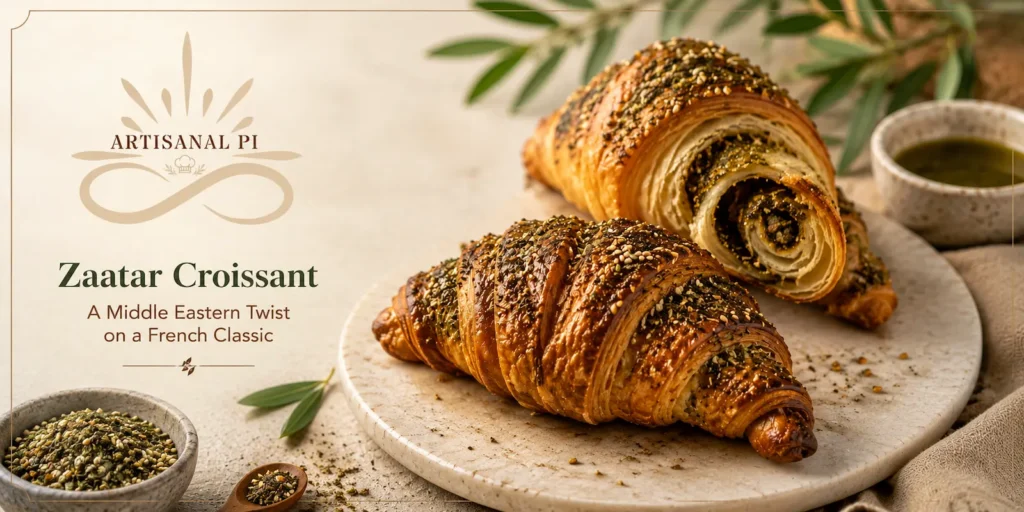
The zaatar croissant is quietly becoming one of the most ordered savoury items on Dubai’s café scene — and most café owners still haven’t added it to their menu.
That is a margin opportunity sitting untouched.
This is not a trend that needs time to prove itself. Zaatar has been part of Levantine food culture for centuries. What changed is the format. When you fold that blend of wild thyme, sumac, sesame, and olive oil into properly laminated, buttery croissant dough, you get something that feels both deeply familiar and genuinely exciting. And in Dubai’s diverse, food-literate market, that combination lands every single time.
What Makes a Zaatar Croissant Different from Any Other Savoury Pastry
A zaatar croissant is a laminated French-style croissant filled, coated, or both with a traditional zaatar blend — wild thyme, sumac, toasted sesame seeds, and olive oil. The result is a savoury pastry that delivers floral, herby, and tangy flavour alongside the rich butteriness of properly laminated dough. No other savoury pastry format achieves this specific flavour contrast.
The key is the zaatar blend itself. Authentic zaatar contains at least four ingredients — thyme as the base, sumac for tartness, sesame for nuttiness, and olive oil to bind. A product using dried thyme alone is not a zaatar croissant. It is a thyme croissant, and the eating experience is completely different.
The second factor is lamination. A properly made croissant has visible, defined layers that shatter on the first bite and give way to a soft, airy interior. That texture contrast is what makes the zaatar flavour bloom — the crunch releases the aromatics immediately. A bread-roll style dough that is simply shaped like a croissant will not deliver the same result, regardless of the filling quality.
Why Dubai’s Café Customers Are Ordering Zaatar Croissants More Than Ever
Dubai’s café culture has evolved significantly. Guests are no longer satisfied with a plain butter croissant and a latte. They want something that reflects the city they are eating in — cosmopolitan, flavour-forward, and rooted in the region’s food identity.
Zaatar is one of the most universally recognised flavours across Dubai’s population. Arab, Levantine, and broader Middle Eastern guests connect with it culturally. Health-conscious guests associate it with clean, herb-based ingredients. International guests experience it as an exciting, authentic regional flavour. It is one of the rare café menu items that genuinely serves everyone.
It also performs across all dayparts. Zaatar croissant at breakfast with black coffee is a cultural staple. At brunch, it sits beautifully alongside eggs and labneh. As an afternoon snack with mint tea, it works equally well. No other savoury pastry in Dubai has this level of daypart flexibility — and that is a significant commercial advantage for any café managing a single morning bake.
The social shareability is real too. The visual of a golden, flaky croissant covered in green zaatar and sesame photographs extremely well. Guest-generated content from a well-presented zaatar croissant consistently outperforms most other breakfast items on Instagram and TikTok.
Zaatar Croissant vs Cheese Croissant: Which One Belongs on Your Menu?
The honest answer is both. But if you are building or refreshing a savoury section and need to make a decision, here is the practical breakdown.
| Factor | Zaatar Croissant | Cheese Croissant |
| Flavour profile | Herby, tangy, aromatic | Rich, savoury, indulgent |
| Customer appeal | Cultural + health-conscious | Comfort + indulgence |
| Daypart performance | All-day, especially morning | Morning and afternoon |
| Perceived health factor | Higher | Lower |
| Best pairing | Black coffee, mint tea | Latte, cappuccino |
| Social shareability | High — herb topping visual | High — cheese pull visual |
Zaatar croissant skews toward the health-aware and culturally connected guest. Cheese croissant skews toward indulgence and comfort. Together, they cover the full morning audience without competing with each other.
Stocking both creates a savoury pair that anchors your morning menu and gives every guest a clear choice. For a deeper breakdown on how cheese croissant performs as a standalone café item, this guide on cheese croissant in Dubai covers everything a café operator needs to know.
What Separates a Great Zaatar Croissant from a Mediocre One
If you are sourcing zaatar croissants for your café, these are the five signals that separate a product worth putting your name behind from one that will quietly damage your reputation:
- Visible lamination layers. When you cut or break the croissant, you should see distinct, defined pastry layers. If it looks like bread inside, the dough was not properly laminated.
- Real zaatar blend — not dried thyme alone. Ask your supplier what the zaatar mix contains. Authentic zaatar has sumac, sesame, and olive oil as non-negotiable components. Anything less is a shortcut.
- No soggy base. Moisture management in a filled or coated croissant is a technical challenge. A quality product maintains crunch on the base even after resting for 30–45 minutes at room temperature — critical for café counter display.
- Consistent weight and size across every unit. Your guests who order the zaatar croissant on Tuesday expect the same product on Saturday. Inconsistent sizing is a supply chain problem that reflects directly on your café’s quality standards.
- Clean finish, not oily surface. Good zaatar has enough olive oil to bind, not so much that it coats the hands on first touch. An oily croissant signals over-application and ingredient imbalance.
These same standards apply whether you are making in-house or sourcing from a B2B wholesale dessert and pastry supplier. The difference is that a reliable supplier maintains these standards at volume, every batch, without you having to supervise it.
How Cafés in Dubai Are Adding Zaatar Croissant to Their Morning Menu Profitably
The margin case for zaatar croissant is straightforward.
Zaatar croissants in Dubai currently retail between AED 18 and AED 35 depending on size, quality, and café positioning. A well-sourced unit from a wholesale supplier costs significantly less per piece at volume. The gross margin on a correctly priced savoury croissant sits comfortably above 60% — placing it among the highest-performing items on a typical café morning menu.
The profitability gets even stronger when you factor in upselling. A guest ordering a zaatar croissant is highly receptive to a drink pairing suggestion. A croissant plus coffee combination order increases the average check by AED 20–25 with almost no additional operational effort.
For cafés managing delivery platform presence, zaatar croissant photographs and describes well in a Talabat or Deliveroo listing. Clear, specific item names with ingredient descriptors (“flaky zaatar and sesame croissant with olive oil”) consistently outperform generic names in click-through and conversion.
If you are still building out your overall breakfast and pastry strategy, the café dessert menu guide for Dubai operators covers the full framework — from menu sizing to food cost calculation in AED.
Bulk Zaatar Croissant Supply for Dubai Cafés and Hotels: What to Look For
Sourcing zaatar croissants at scale introduces operational questions that individual retail purchase does not. Here is what matters for B2B buyers:
- Minimum order quantity (MOQ). Know your weekly volume before approaching a supplier. A supplier whose MOQ exceeds your weekly demand creates waste. One whose MOQ is too low may not be set up for consistent commercial supply.
- Delivery frequency and lead time. For a morning menu item, you need reliable delivery aligned with your prep schedule. Confirm whether the supplier delivers fresh or frozen-to-bake, and what the thaw or proof time is.
- Batch consistency. Ask for a sample from multiple batches, not just one. A single good batch means nothing. Three consistent batches means the production process is controlled.
- Shelf life and storage requirements. Fresh zaatar croissants have a shorter counter life than frozen-and-baked options. Understand the product’s shelf life at room temperature and refrigerated to manage waste effectively.
- Customisation capability. If you want a branded or exclusive version of the zaatar croissant for your concept — a specific size, a unique filling ratio, your label on the packaging — you need a supplier with co-creation capability, not just a catalogue.
Artisanal Pi’s Palate Laboratory exists specifically for that last point. If you want a signature zaatar croissant that belongs to your café and cannot be ordered from anyone else, that is exactly what the Palate Laboratory delivers.
Zaatar Croissant by Artisanal Pi: Handcrafted, Consistent, Bulk-Ready
Dessert Soleil is the indulgent brand within Artisanal Pi — built for guests who appreciate bold flavours and exceptional quality in every bite. The zaatar croissant sits naturally within this range: visually striking, technically demanding to produce well, and deeply satisfying to eat.
Every zaatar croissant produced under the Artisanal Pi umbrella is handcrafted — proper lamination, authentic zaatar blend, consistent portion weight, and the kind of finish that holds up on a café counter and photographs well without any styling effort.
For café owners and hotel F&B managers in Dubai who want a zaatar croissant they can stand behind — one that tastes as good on the hundredth order as it did on the first — get in touch with the Artisanal Pi team. Bring your volume, your concept, and your questions. The conversation is the first step.
Artisanal Pi is a Dubai-based artisanal dessert and pastry studio at Cityland Mall, supplying cafés, hotels, and restaurants across the UAE. Contact the team at business@artisanalpi.com or WhatsApp +971 56 124 1728.
Frequently Asked Questions About Zaatar Croissant
What is a zaatar croissant?
A zaatar croissant is a laminated, buttery French-style croissant filled or coated with zaatar — a traditional Levantine blend of wild thyme, sumac, toasted sesame seeds, and olive oil. It delivers a savoury, herby, and tangy flavour profile against rich, flaky pastry layers. It is one of the most culturally resonant savoury pastries in Dubai’s café market.
Why is zaatar croissant popular in Dubai cafés?
Zaatar croissant is popular in Dubai because zaatar is a deeply familiar flavour across the city’s Arab, Levantine, and broader Middle Eastern population, while also appealing to international guests as an authentic regional experience. It performs across all dayparts, photographs extremely well for social media, and carries strong gross margins — making it commercially attractive for café operators as well as culturally appealing to guests.
What is the difference between zaatar croissant and cheese croissant?
A zaatar croissant delivers herby, tangy, aromatic flavour and appeals to health-conscious and culturally connected guests. A cheese croissant delivers rich, indulgent, comfort-driven flavour. Stocking both covers the full savoury morning audience without menu overlap. The two products complement each other perfectly as a paired savoury offering on any Dubai café counter.
Can I order zaatar croissants in bulk for my café in Dubai?
Yes. Several Dubai-based artisanal suppliers offer B2B wholesale supply of zaatar croissants for cafés and hotels. When evaluating suppliers, confirm minimum order quantities, delivery frequency, batch consistency, and whether customisation is available.
What makes a good zaatar croissant for a café menu?
A quality zaatar croissant for a café menu must have visible lamination layers, authentic zaatar blend with sumac and sesame, a crisp base that holds at room temperature, consistent portion weight across every unit, and a clean finish without excess oil. These are the five signals that distinguish a product worth putting your café’s name behind from one that will underperform on counter and on delivery platforms.
How do I find a reliable zaatar croissant supplier in Dubai?
Look for a supplier with proven B2B hospitality experience, transparent ingredient sourcing, and demonstrated batch consistency. Request samples from multiple production runs, not just one. Confirm delivery logistics, minimum order quantities, and whether they offer customisation for branded or exclusive products.